UFC Betting Guide
How Does UFC Betting Work: The Complete UK Guide to MMA Wagering
 Available in US
Table of Contents
- What You Need to Know Before Placing Your First UFC Bet
- How UFC Betting Works: Core Mechanics
- Types of UFC Bets Explained
- UFC Betting in the United Kingdom
- How to Analyse a UFC Fight Before You Bet
- The UFC Betting Market in 2025-2026
- Betting Integrity and Match-Fixing in the UFC
- Pitfalls to Watch Out For
- Frequently Asked Questions About UFC Betting

I placed my first UFC bet in 2017 on a Saturday night in Manchester, hunched over my phone while the prelims rolled through on BT Sport. The stake was small — ten quid on a method of victory — and I got it spectacularly wrong. What I got right, eventually, was the process: learning to read odds, understanding what the numbers actually mean, and figuring out that the octagon rewards a different kind of analysis than football or horse racing. Nine years later, I still find UFC one of the most intellectually satisfying sports to wager on, precisely because the market is thinner, the variables are wilder, and the edge available to anyone willing to do the work is real.
The MMA betting handle hit $10.3 billion globally in 2024, a 17% jump year on year, and the UK’s remote gambling sector generated GGY of £7.8 billion across the same period. Those are not niche numbers. They reflect a market that has moved from the margins of the sportsbook into a mainstream category with dedicated odds, live markets and event-specific promotions at every major licensed operator. Whether you have never placed a combat sports bet or you have been dabbling for a while and want sharper tools, this guide walks through the mechanics, the maths and the practical realities of betting on UFC fights from a UK punter’s perspective.
Everything here assumes you are betting with a UKGC-licensed bookmaker — the only legal way to wager on UFC in Britain. I will cover how odds work across all three formats you will encounter, every major bet type from moneyline to method of victory, the analytical framework I use before risking a penny, and the regulatory landscape that shapes the market. The aim is not to tell you what to bet on. It is to give you a system for deciding that yourself.
What You Need to Know Before Placing Your First UFC Bet
- UFC betting in the UK is legal and regulated under the Gambling Act 2005 — use only UKGC-licensed bookmakers.
- The moneyline (picking the winner) is the foundation, but method of victory and over/under markets let you express sharper opinions on how a fight unfolds.
- Favourites win roughly 72% of UFC bouts, meaning underdogs hit often enough to keep the market honest.
- Division-level finish rates vary dramatically — heavyweights finish by KO/TKO 49% of the time, while women’s strawweight goes to decision in 67% of fights.
- Always compare odds across multiple bookmakers and track every bet you place. Process beats intuition over time.
How UFC Betting Works: Core Mechanics
The first UFC event I ever watched without betting felt completely different from the first one I watched with money on the line. Suddenly I was noticing footwork in the first thirty seconds, tracking takedown attempts, counting significant strikes between rounds. That shift in attention is what draws people to combat sports betting — and it all starts with understanding a few core mechanics that separate MMA from any team sport you have wagered on before.
At its simplest, a UFC bet is a prediction about the outcome of a fight between two people. There is no team to absorb a bad day. No substitute coming off the bench. One fighter wins, one loses, and the rare draw or no-contest returns your stake on most markets. That binary structure is what makes the moneyline — a straight bet on who wins — the foundation of UFC wagering.
Moneyline — A bet on which fighter will win the bout, regardless of how or when the victory occurs. It is the most common and straightforward UFC wager.
Every UFC bout at a licensed bookmaker opens with a set of odds that reflect the market’s assessment of each fighter’s chance of winning. Those odds determine two things: how much you stand to win relative to your stake, and the implied probability the market assigns to each outcome. Favourites in the UFC won roughly 72% of all bouts in 2024, which tells you the market gets it right more often than not — but that 28% underdog win rate is where the interesting questions live.
Vig — The bookmaker’s margin built into the odds. Also called “juice” or “overround”, it ensures the combined implied probabilities of all outcomes exceed 100%, guaranteeing the operator a theoretical profit regardless of the result.
Stake — The amount of money you place on a bet. In the UK, minimum stakes vary by bookmaker but typically start between £0.10 and £1.
Here is how the process works in practice. A UFC event card is announced, typically three to six weeks before fight night. Bookmakers post opening odds — sometimes earlier for high-profile bouts, sometimes only a fortnight out for Fight Night cards. Those odds shift as money comes in, as fight-week news breaks, and as the weigh-ins reveal who made weight and who looked drained doing it. By the time the cage door closes, you have had weeks of data to process, and the closing line represents the market’s sharpest, most informed price.
Your job as a bettor is not to predict winners. It is to identify spots where the odds on offer are more generous than the actual probability of the outcome. That distinction matters enormously. A fighter who wins 60% of the time is a bad bet at odds that imply a 70% chance, and a brilliant bet at odds that imply a 45% chance. Everything in this guide feeds back to that principle: finding the gap between the market’s price and your own informed assessment.
With the core logic in place, let’s break down the two building blocks you will use most: the moneyline and the three odds formats UK punters encounter.

Moneyline: Picking the Winner
A moneyline bet strips away every complication and asks one question: who wins? You pick a fighter, place your stake, and if they get their hand raised — by knockout, submission or decision — you collect. If they lose, your stake is gone. No points, no spread, no partial credit.
Example: Fighter A vs Fighter B
Fighter A: 4/11 (heavy favourite)
Fighter B: 5/2 (underdog)
A £22 stake on Fighter A at 4/11 returns £8 profit plus your £22 stake = £30 total.
A £10 stake on Fighter B at 5/2 returns £25 profit plus your £10 stake = £35 total.
The favourite’s odds are always shorter — lower potential profit per pound staked — because the market considers them more likely to win. The underdog’s odds are longer, offering a bigger payout to compensate for the higher risk. In fractional terms, if the number on the left is smaller than the number on the right (like 4/11), you are looking at a favourite. If the left number is larger (like 5/2), that is an underdog.
Calculating your moneyline payout
Step 1: Take the fractional odds — say 5/2.
Step 2: Divide the first number by the second: 5 / 2 = 2.5.
Step 3: Multiply by your stake: 2.5 x £10 = £25 profit.
Step 4: Add your original stake: £25 + £10 = £35 total return.
What makes the moneyline particularly interesting in UFC is that two-outcome markets are inherently simpler to analyse than, say, a football match with its three-way result (home, draw, away). There is no draw on a UFC moneyline — if the fight ends in a draw, most bookmakers void the bet and return your stake. That simplicity is a double-edged sword: it is easy to understand but difficult to find value in, because the market is efficient and every punter is looking at the same two options.
Reading Odds: Fractional, Decimal and American
Walk into any UK bookmaker’s app and the odds on a UFC fight will default to fractional format — the same style you see on horse racing and Premier League. But UFC is a global sport, and if you are reading analysis from American or European sources, you will run into decimal and American formats constantly. All three express the same information in different packaging.
| Format | Favourite Example | Underdog Example | Where Used |
|---|---|---|---|
| Fractional | 4/11 | 5/2 | UK, Ireland |
| Decimal | 1.36 | 3.50 | Europe, Australia |
| American | -275 | +250 | USA, Canada |
Fractional odds tell you the profit relative to your stake. At 5/2, you earn £5 for every £2 wagered. Decimal odds include your stake in the return figure — at 3.50, a £10 bet returns £35 total (£25 profit plus your £10 back). American odds use a baseline of $100: a minus figure like -275 tells you how much to stake to win $100 profit, while a plus figure like +250 tells you how much you win on a $100 stake.
Implied probability — The percentage chance of an outcome that the odds represent, before removing the bookmaker’s margin. At fractional odds of 4/11, the implied probability is 11 / (4 + 11) = 73.3%.
Converting between formats is straightforward once you memorise a couple of formulas. Fractional to decimal: divide the fraction, then add 1. So 5/2 becomes (5 / 2) + 1 = 3.50. Decimal to fractional: subtract 1, then express as a fraction. So 1.36 becomes 0.36, or roughly 4/11. The reason I recommend getting comfortable with decimal odds specifically is that they make implied probability calculations painless and they are the format most live odds feeds use.
For step-by-step payout calculations in every format, with real card examples, see our full breakdown of UFC betting odds.
Types of UFC Bets Explained
About three years into my betting life I realised I had been leaving money on the table by sticking exclusively to moneylines. The moment I started exploring method of victory and over/under markets, my entire approach changed — not because those bets are inherently better, but because they let you express more specific opinions about how a fight will unfold, not just who wins.
UFC markets fall into a handful of categories. The moneyline is the backbone, but the real texture of MMA wagering lives in the bets that ask you to predict the nature of the victory, the timing, or some combination of the two. Across the sport, roughly 45% of fights end by KO or TKO, 25% by submission and 30% by judges’ decision. Those proportions shift dramatically depending on weight class, which is precisely what makes specialised bet types valuable — they reward punters who understand the matchup rather than just the name.
| Bet Type | What You Predict | Typical Odds Range | Best For |
|---|---|---|---|
| Moneyline | Who wins | Short favourite to long underdog | High-confidence picks |
| Method of Victory | KO/TKO, submission or decision | Longer odds, higher payouts | Style matchup analysis |
| Over/Under Rounds | Fight goes above or below a round total | Roughly even both sides | Fight pace analysis |
| Round Betting | Exact round the fight ends | Very long odds | Finish timing specialists |
| Props and Specials | Various: goes the distance, first knockdown, etc. | Varies widely | Niche knowledge |
| Parlays (Accumulators) | Multiple selections must all win | Combined odds, high payout | Small stakes, high risk |
The overall UFC finish rate sits at 53%, meaning just over half of all bouts end before the judges’ scorecards are needed. That single number is the starting point for any over/under or method of victory wager — and it moves sharply when you drill into individual weight classes. Heavyweights finish inside the distance far more often than strawweights, and that difference alone can flip the expected value of a bet.
Knowing that heavyweights finish 49% of the time by knockout only helps once you know what price that rate deserves. This converts a division’s finish profile into fair odds for every method and distance market, then checks the price you have been offered against it.
| Market | Base rate | Fair price | Your fighter | Fair price |
|---|---|---|---|---|
| KO/TKO | 49,0 % | 2,04 | 29,4 % | 3,40 |
| Submission | 22,4 % | 4,46 | 13,4 % | 7,44 |
| Decision | 28,6 % | 3,50 | 17,2 % | 5,83 |
| Goes the distance — yes | 28,6 % | 3,50 | — | — |
| Goes the distance — no | 71,4 % | 1,40 | — | — |
The left-hand columns price the market without caring who wins — useful for distance and method-only bets. The right-hand columns multiply the division rate by your fighter’s win probability, which is the naive combination and slightly understates correlated cases: a fighter who wins usually wins by the method their style favours, so a knockout artist’s KO price should sit a little shorter than the raw product suggests. Books build that correlation in, which is why a method-and-winner combo rarely prices exactly at the multiplication. Two cautions about the base rates themselves. First, they describe the division, not the matchup — two counter-strikers in a heavyweight bout do not inherit the 49% knockout rate, and the honest use of these numbers is as a prior you then move, not an answer. Second, the finish rates quoted across this guide are not internally consistent: a 45% KO plus 25% submission split implies a 70% finish rate, while the stated overall finish rate is 53%, which with a 60/40 split of finishes gives 31,8% and 21,2% instead. Both versions are in the division selector so you can see how much the prices move — the fair KO price shifts from 2,22 to 3,14 between them, which is a large gap for a single market. Where a figure matters to a bet, source it at division level rather than relying on a headline average. More in the guides to KO percentage by weight class, bet types and implied probability. 18+, UKGC-licensed bookmakers only; BeGambleAware.
Each of these categories deserves its own explanation, so let's walk through the ones that UK bookmakers offer most consistently.
Method of Victory Bets
A method of victory bet asks you to predict not just who wins but how they win. The standard categories are KO/TKO, submission and decision — though some bookmakers split it further, offering "Fighter A by KO/TKO", "Fighter A by submission", "Fighter A by decision" and the same three options for Fighter B. That gives you six possible selections on a single bout, each at longer odds than the straight moneyline.
Heavyweight
49% KO/TKO rate — the highest of any division. Only 28.6% of bouts reach the scorecards.
Women's Strawweight
Just 13.4% KO/TKO rate. A staggering 66.9% of fights go to decision — the most judge-dependent division in the UFC.
Overall UFC
Of all finishes, roughly 60% come by KO/TKO and 40% by submission — though the split varies wildly by division.
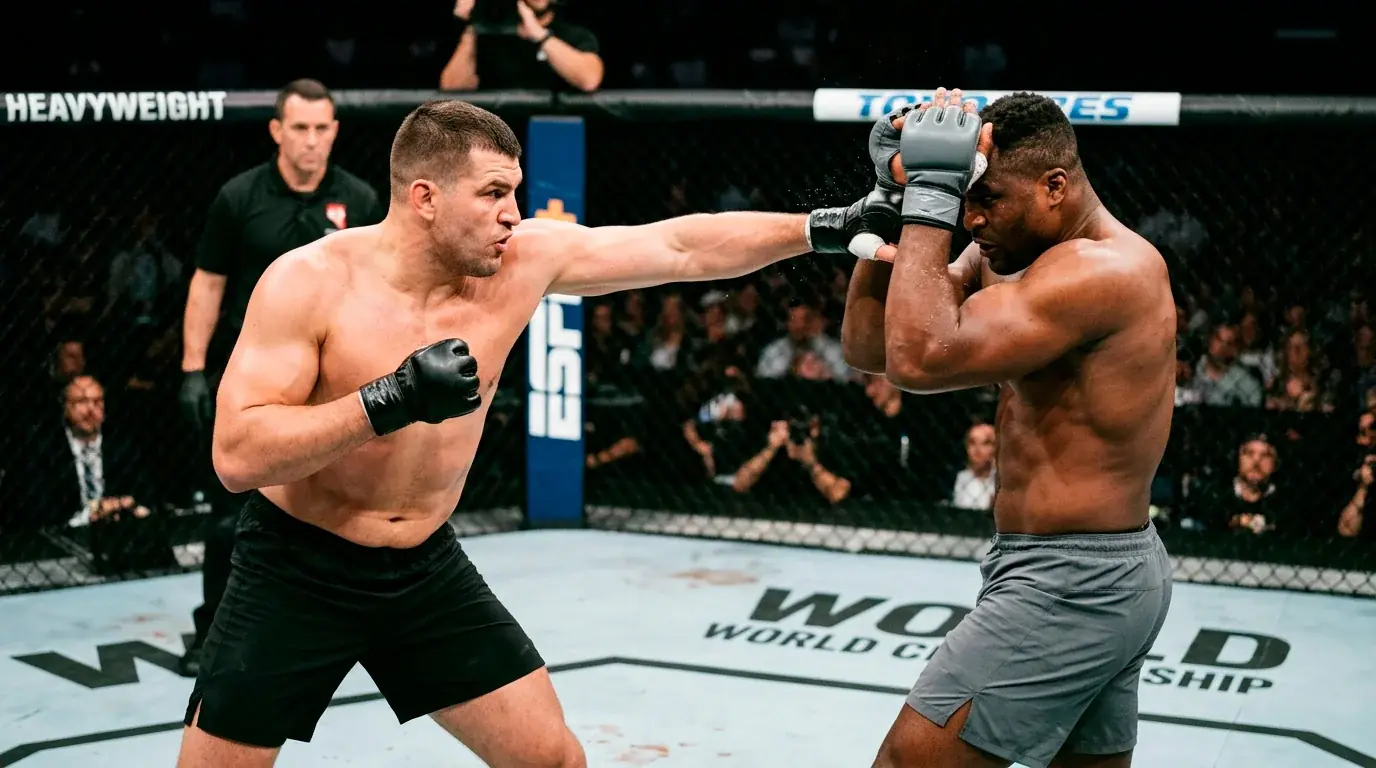
This is where division-level data becomes genuinely actionable. Backing "by KO/TKO" in a heavyweight main event is a statistically reasonable position; backing the same method at women's strawweight is fighting the numbers. I tend to use method of victory bets when the style matchup strongly suggests a particular finish type — a powerful knockout artist against a fighter with poor takedown defence, for instance, narrows the likely outcomes considerably. The odds on the specific method often carry more value than the moneyline because the market has to price six outcomes instead of two, and that complexity creates gaps.
Over/Under Rounds
An over/under bet sets a line — typically 1.5 or 2.5 rounds for a three-round fight, or 2.5 or 3.5 for a five-round championship bout — and you wager on whether the fight will last longer or shorter than that number. The half-round ensures there is no push: either the fight ends before the midpoint of the specified round, or it does not.
Example: Three-round bout, line set at 1.5 rounds
Over 1.5 rounds: 4/9 (fight survives past the halfway mark of round 2)
Under 1.5 rounds: 7/4 (fight ends in round 1 or before 2:30 of round 2)
The beauty of over/under markets is that they let you express a view on fight pace without committing to a winner. If two durable grapplers are meeting and you expect a grinding, clinch-heavy affair but have no strong lean on the winner, the over is a natural play. Conversely, when a devastating finisher faces someone with a glass chin, the under becomes attractive regardless of which fighter you think lands the shot.
I find these bets most useful at the extremes of the weight spectrum. Heavyweight bouts trend heavily toward early finishes — that 49% KO/TKO rate is not evenly distributed across rounds but clusters in rounds one and two. At flyweight and strawweight, the decision rates are high enough that "over" on a generous line often represents solid expected value. The key is matching the line to the specific matchup rather than relying on divisional averages alone.
Props, Parlays and Specials
Parlay (Accumulator) — A single bet that combines two or more selections. Every leg must win for the parlay to pay out. The odds multiply together, creating larger potential returns but significantly lower probability of success.
Accumulator (Acca) — The UK term for a parlay. Same mechanics, same maths, different name. You will see both terms used interchangeably by UK bookmakers offering UFC markets.
Prop bets — short for proposition bets — cover anything that is not a straight moneyline or method of victory. "Goes the distance" (yes or no), "fight to start round 3", "first fighter to score a knockdown" and "fighter to win in round 1" are all prop markets you will encounter at most UK sportsbooks. The range of available props depends on the profile of the fight: a pay-per-view main event will have twenty or more prop options, while a Fight Night prelim might offer only three or four beyond the moneyline.
Parlays deserve a cautious introduction. Combining three moneyline favourites into an accumulator feels safe because each leg seems likely — but the maths cuts the other way. If each favourite has a 70% chance of winning, a three-leg parlay has roughly a 34% chance of hitting, and the offered odds rarely compensate fully for that compounded risk. I use parlays sparingly and only when I have strong, independent reasons for each leg. Correlated parlays — where one outcome makes another more likely — can occasionally offer structural value, but that is advanced territory covered in our guide to every UFC bet type.
UFC Betting in the United Kingdom
I remember having a conversation with a mate in 2019 who was convinced you needed some kind of special account to bet on UFC in Britain — as though MMA existed in a regulatory grey zone. It does not. UFC betting in the UK is legal, regulated and available at every major licensed sportsbook. The framework that governs it is the same one that covers your Saturday football accumulator or your Grand National each-way: the Gambling Act 2005, enforced by the UK Gambling Commission.
The UK remote gambling sector — which includes all online sports betting — generated £7.8 billion in gross gambling yield between April 2024 and March 2025, a 13.1% increase year on year. UFC occupies a growing slice of that market. The sport's event calendar runs nearly year-round, with cards scheduled most weekends, and UK bookmakers have responded by expanding their MMA coverage substantially over the past five years. You can now find pre-fight moneylines, method of victory, round betting and live in-play markets at all the operators you already use for other sports.
UKGC licence check — Before depositing money with any bookmaker, verify their licence at the Gambling Commission's public register. Every legally operating UK sportsbook displays its licence number in its website footer. If you cannot find it, do not bet there.
About 10% of UK adults participate in online sports betting, with a notable gender split: 15% of men place sports bets compared to 4% of women. The broader gambling participation figure is higher still — 48% of UK adults engaged in some form of gambling within a four-week period according to the most recent Commission survey. These numbers reflect a market that is mature, accessible and closely monitored by a regulator that takes enforcement seriously.
Responsible gambling matters. If betting stops being entertainment, tools exist to help. Every UKGC-licensed bookmaker is required to offer deposit limits, loss limits, reality checks and self-exclusion options. GamStop provides a single self-exclusion registration that covers all licensed UK operators. Use the tools before you need them, not after.

The practical experience of betting on UFC in Britain comes with one quirk that catches newcomers off guard: timing. Most UFC events are held in North America, which means main cards typically start between 1am and 5am UK time. If you are planning to bet live during a fight, be prepared for late nights or early mornings. Saturday-night UFC cards in Las Vegas translate to Sunday-morning sessions in London, and I have lost count of the alarms I have set for 3am to catch a main event. Bookmakers keep their UFC markets open through these hours, but it is worth checking that your chosen operator's in-play platform is fully functional at those times — not all live feeds are equally responsive in the small hours.
UKGC Regulation and the Gambling Act 2005
The Gambling Act 2005 is the legal foundation for all commercial gambling in the UK, and it applies to UFC and MMA betting exactly as it does to any other sport. The Act requires every operator offering betting services to UK consumers to hold a licence from the Gambling Commission, regardless of where the operator is physically based. Remote operators — meaning anyone running an online sportsbook — must hold a specific remote operating licence to serve the UK market.
The scale of enforcement is worth understanding. Between April and December 2025 alone, the UKGC issued 592 cease and desist orders to unlicensed operators and advertisers, and successfully had 203,571 URLs removed from search engine results. Tim Miller, a director at the Commission, has been vocal about the crackdown, noting the sheer volume of illegal operators attempting to reach UK consumers. That enforcement effort protects you directly: licensed bookmakers are subject to conditions around fair terms, dispute resolution, funds segregation and responsible gambling tools.
The regulatory landscape is not static. The 2025 Budget introduced a new remote betting duty of 25%, set to take effect from April 2027, with projected revenue of £810 million in its first year. That duty is paid by operators, not punters — your winnings remain tax-free. But it will affect the market indirectly: operators absorbing a higher tax burden may adjust their margins, which could show up as slightly less generous odds across all sports including UFC. For a deeper exploration of how the Act specifically applies to MMA and what upcoming changes might mean, our article on UFC betting legality in the UK covers the full picture.
How to Analyse a UFC Fight Before You Bet
Early on I made the same mistake every new UFC bettor makes: I watched highlights, formed an opinion based on who looked more impressive in a two-minute clip, and bet accordingly. The problem with that approach is not that it never works — it does, occasionally — but that it gives you no framework for evaluating why you were right or wrong. And without that framework, you cannot improve.
Fight analysis for betting purposes is not the same as fight analysis for enjoyment. You are not asking "who would I rather watch?" or "who has the cooler style?" You are asking a more precise question: given the odds the bookmaker is offering, is the probability of this outcome higher than the market implies? That requires data, and it requires a process for turning data into a view.
Bouts where southpaw fighters meet orthodox opponents finish inside the distance 18% more frequently than fights between two orthodox or two southpaw fighters. That is not a prediction about any individual fight, but it is the kind of structural edge that should inform your analysis when relevant. Fight data is full of these patterns, and the punters who consistently find value are the ones who know which patterns matter and which are noise.
Pre-bet analysis checklist
- Review each fighter's recent form: last 3-5 bouts, level of opposition, how they won or lost
- Compare striking output and accuracy using significant strikes per minute and striking defence percentage
- Check takedown averages and takedown defence for both fighters
- Identify the style matchup: striker vs grappler, southpaw vs orthodox, pressure fighter vs counter-striker
- Note any schedule or camp changes: new coach, short-notice replacement, injury history
- Check the weigh-in results for signs of a difficult weight cut
- Compare the bookmaker's implied probability to your own assessment of the fight
I run through this list for every fight I consider betting on. It takes about fifteen to twenty minutes per bout if you are working from a stats site, and it dramatically reduces the number of bets you place — which, counterintuitively, is a good thing. Fewer, better-informed bets beat a scatter-gun approach every time.
Significant Strikes per Minute
The volume of meaningful strikes a fighter lands per minute of cage time. Higher is not always better — context matters.
Takedown Average
How many takedowns a fighter lands per 15 minutes. Crucial for predicting whether a fight stays standing or goes to the mat.
Striking Defence
Percentage of incoming significant strikes avoided. High defence correlates with durability and the ability to survive into later rounds.

The real skill is not in collecting data — it is in weighting it. A fighter with an 80% takedown defence rate sounds sturdy until you realise their last three opponents were all strikers who attempted fewer than two takedowns per bout. Context always trumps raw numbers, and that is what separates a statistical analysis from a genuine fight prediction.
Key Fighter Metrics That Matter
SLpM (Significant Strikes Landed per Minute) — A measure of striking volume that filters out clinch taps and minor shots. The UFC average is roughly 3.4 SLpM, but elite strikers operate well above 5.0.
TD Avg (Takedown Average) — The number of successful takedowns per 15 minutes of fight time. High-level wrestlers typically sit above 3.0, while pure strikers hover near zero.
Significant Strikes — Any strike at distance or on the ground that the referee considers meaningful. Jabs, power shots, kicks and elbows all count; clinch pitter-patter usually does not.
Three metrics consistently carry the most predictive weight in my pre-fight analysis. First, SLpM tells you whether a fighter creates volume on the feet. A high SLpM paired with a strong striking accuracy percentage (above 50%) signals a fighter who can hurt opponents at range. Second, takedown average versus takedown defence reveals who controls where the fight takes place. A grappler averaging 4.0 takedowns per 15 minutes against an opponent who defends only 55% of attempts has a clear path to dictating the fight. Third, striking defence is the metric most bettors undervalue. A fighter who absorbs fewer significant strikes per minute tends to survive longer, which directly affects over/under and method of victory bets.
The submission rate across the UFC sits at about 20% and has been gradually declining over recent years, with rear-naked chokes remaining the most common finish type on the ground. That trend matters if you are betting method of victory: submission finishes are becoming less frequent as wrestling-based fighters increasingly prioritise ground-and-pound over positional grappling. For a detailed guide to turning these numbers into betting decisions, see our piece on UFC betting strategy and fight analysis.
The UFC Betting Market in 2025-2026
The global MMA betting handle — the total amount wagered — reached $10.3 billion in 2024, a 17% increase from the previous year. To put that in context, a decade ago that figure was barely a rounding error on the global sportsbook ledger.
When I started covering UFC betting in 2017, you had to scroll past three pages of football markets to find MMA at most UK bookmakers. Today it sits alongside tennis and basketball in the top tier of individual sport categories, and the numbers explain why. UFC generated $1.502 billion in revenue in 2025 with an EBITDA margin of 57% — among the highest of any major sports organisation on the planet. That financial muscle translates directly into betting market depth: more events, more media coverage, more eyeballs, and more money flowing through the odds.
The commercial engine behind that growth has several moving parts. Sponsorship revenue climbed to $314.3 million in 2025, a $62.9 million increase that represented the single largest contributor to UFC's annual revenue growth. Media rights generated $907.7 million, anchored by the landmark seven-year, $7.7 billion deal with Paramount signed in August 2025. TKO Group Holdings — the parent company that owns both UFC and WWE — is projecting revenue between $5.675 and $5.775 billion for 2026, roughly 20% above the 2025 figure. Ariel Emanuel, TKO's executive chair, described the organisation as "extremely well positioned with long-term media rights agreements in place and operational strength across the business."
bet365 partnership — In March 2026, bet365 replaced DraftKings as the UFC's official betting partner in the US and Canada on a five-year deal. Trip Stoddard, bet365's head of development, called UFC's "always-on event calendar and highly engaged global fanbase" a natural fit for real-time betting. While the partnership is focused on North America, it signals the growing commercial importance of betting to the UFC's business model and has implications for how odds are framed and promoted globally.
The broader market for MMA and boxing betting is valued between $1.5 and $3.2 billion depending on the methodology, with analysts projecting compound annual growth of 9% to 14% through to 2033. What drives that projection is not just UFC — though UFC dominates the handle — but the structural fit between combat sports and modern betting behaviour. Fights happen on a fixed schedule, last a defined number of rounds, and produce dramatic momentum swings that lend themselves to live wagering. UFC events already generate 11% of all live-bet clicks on major platforms during fight nights, a figure disproportionately high relative to the sport's overall market share. The market is not just growing — it is maturing, attracting sharper money and more sophisticated products.
Betting Integrity and Match-Fixing in the UFC
No conversation about UFC betting is complete without addressing the elephant in the octagon: match-fixing. I have had people tell me that MMA is too chaotic to fix, that two fighters cannot choreograph a convincing loss. The recent history of the sport suggests otherwise — not because fixing is widespread, but because the attempts that have surfaced were caught precisely because the betting market noticed before anyone else did.
Integrity matters to your bets. When a fight is flagged for suspicious betting activity, bookmakers may void all wagers on that bout and return stakes. Understanding the integrity landscape protects you from placing money on compromised events.
The most prominent recent case involved Isaac Dulgarian, a UFC fighter dismissed by the organisation in November 2025 after IC360 — the independent integrity monitoring service used by major sportsbooks — flagged anomalous betting patterns on one of his bouts. Dana White described receiving a call from the integrity service alerting UFC to unusual action, after which the organisation contacted the fighter and his legal team. Both Caesars and William Hill voided all bets placed on the fight. Dulgarian had previously spoken openly in interviews about fans telling him how much money they made betting on his fights, joking that he should receive a percentage. The joke aged poorly.

That incident followed a pattern established in 2022 when trainer James Krause received a lifetime ban from the UFC after a betting scandal connected to his fighter Darrick Minner's bout. The fallout was severe enough that AGCO, Ontario's gambling regulator, temporarily suspended all UFC betting in the province — an unprecedented step that demonstrated how seriously regulators treat integrity breaches in combat sports.
The most recent case came in January 2026, when White pulled a fight from the UFC 324 card entirely after receiving another call from the gaming integrity service. His response was unequivocal — he told the press he had been through this before and was not willing to let a compromised fight proceed. That willingness to cancel a bout rather than let it proceed under a cloud represents a significant shift in how the UFC handles integrity concerns — previously the organisation tended to investigate after the fact rather than act pre-emptively.
For UK bettors, the practical takeaway is straightforward. Bet with UKGC-licensed operators who participate in integrity monitoring programmes, pay attention to dramatic late line movement on lower-profile fights, and understand that if a fight is voided for integrity reasons your stake will be returned. The system is not perfect, but it is actively policed, and the consequences for fighters and their associates are career-ending.
Pitfalls to Watch Out For
I keep a spreadsheet of every UFC bet I have placed since 2018. Not for sentimental reasons — for pattern recognition. And the patterns that cost me the most money in my first two years were not bad picks. They were bad processes repeated over and over because I did not know they were bad.
Do
- Set a bankroll and a fixed unit size before you place a single bet. Decide what 1% to 3% of your bankroll looks like and stake consistently.
- Compare odds across at least three licensed bookmakers before placing any wager. The same fight can carry meaningfully different prices.
- Record every bet you make — stake, odds, reasoning, result. Without data on your own performance, you are guessing about what works.
- Focus on specific weight classes or fight types where you can develop genuine expertise rather than betting every card top to bottom.
Don't
- Chase losses by increasing your stake after a losing night. The next card does not know you lost money on the last one.
- Stack heavy favourites into parlays because each leg "seems safe". Favourites win 72% of the time individually, but three 72% legs combined hit only 37% of the time — and the odds rarely compensate.
- Rely on MMA math — the idea that because Fighter A beat Fighter B, and Fighter B beat Fighter C, Fighter A must beat Fighter C. Styles make fights, and transitive results do not hold in combat sports.
- Bet on name recognition alone. A fighter's reputation often lags behind their current form by months or even years.
The favourite-stacking issue deserves extra emphasis because it is the single most common structural mistake I see from newer bettors. A 72% favourite win rate sounds reassuring until you calculate the implied probability of stringing three or four together. The maths works against you quickly, and the vig the bookmaker charges on each leg compounds the problem. Parlays can have a place in a disciplined strategy, but they should never be the strategy.
The MMA math fallacy is subtler and more insidious. Combat sports outcomes depend on specific stylistic interactions, not transitive chains of results. A wrestler who dominated a striker might lose to a different striker whose footwork neutralises the takedown threat entirely. Every fight is its own event, and treating past results as a predictive chain is one of the fastest ways to talk yourself into a bad bet.
Frequently Asked Questions About UFC Betting
How does UFC betting work for beginners in the UK?
UFC betting works the same way as any other sports bet at a UKGC-licensed bookmaker. You open an account, deposit funds, navigate to the MMA or UFC section, and select a market — the most common being the moneyline, where you simply pick which fighter will win. Odds are displayed in fractional format by default at UK sportsbooks, and your potential payout is calculated from those odds multiplied by your stake. Beginners should start with moneyline bets on fights they have researched, keeping stakes small and consistent until they develop a feel for how the markets behave.
What types of bets can you place on a UFC fight?
UK bookmakers typically offer moneyline (match winner), method of victory (KO/TKO, submission or decision), over/under rounds, round betting (exact round of finish), prop bets (such as "goes the distance" or "fight to start round 3"), and parlays (accumulators) that combine multiple selections. Higher-profile events tend to have a wider range of prop markets, while lower-card fights may only offer moneyline and a handful of additional options.
How do I read fractional odds on a UFC bout?
Fractional odds show your profit relative to your stake. At 5/2, you earn £5 for every £2 staked — so a £10 bet returns £25 profit plus your £10 stake for a £35 total. When the left number is smaller than the right (like 4/11), the fighter is the favourite: you stake £11 to win £4 profit. To calculate implied probability from fractional odds, divide the right number by the sum of both numbers. At 5/2, that is 2 / (5 + 2) = 28.6%, meaning the market gives the fighter roughly a 29% chance of winning.
Is it legal to bet on UFC fights in the United Kingdom?
Yes. UFC betting is fully legal in the UK under the Gambling Act 2005, provided you use a bookmaker licensed by the UK Gambling Commission. All major UK sportsbooks offer UFC markets. The UKGC requires licensed operators to meet strict conditions around fair terms, responsible gambling tools and customer funds protection. Your winnings from UFC bets are not subject to income tax — the tax obligation falls on the operator under the remote betting duty.
What is a parlay (accumulator) in UFC betting?
A parlay, known as an accumulator or acca in the UK, combines two or more individual selections into a single bet. All legs must win for the bet to pay out. The odds of each selection multiply together, creating a larger potential return but a significantly lower probability of winning. For example, combining three moneyline favourites at 1/2, 4/7 and 2/5 produces combined odds that pay more than any single bet would, but the chance of all three winning is much lower than each one individually. Parlays amplify both potential reward and risk.
How much money is wagered on UFC fights globally?
The global MMA betting handle reached $10.3 billion in 2024, a 17% increase year on year. UFC accounts for the vast majority of that figure, as it is by far the dominant MMA promotion worldwide. The broader combat sports betting market is projected to grow at a compound annual rate of 9% to 14% through 2033, driven by the sport's expanding media presence, the rise of live in-play betting and a growing global fanbase that the UFC estimates at over 700 million people.
What tools can I use to research UFC fights before betting?
The most widely used free resource is UFCStats.com, which provides detailed per-fighter statistics including significant strikes landed and absorbed per minute, takedown averages, striking accuracy and defence percentages. Beyond that, MMA media sites publish pre-fight breakdowns and matchup analysis for most cards. Odds comparison tools help you find the best available price across licensed UK bookmakers. I also recommend tracking your own bets in a spreadsheet — recording your reasoning alongside results is the single most effective way to identify what is working and what is not in your analysis process.
Created by the ”how Does ufc Betting Work” editorial team.